Showing posts with label adults. Show all posts

Tuesday, August 21, 2012

Crying at the Supermercado


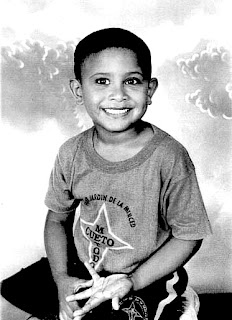
In the year 1994, Rolandito Salas Jusino was born. I was four that year. He was four when he disappeared.

In other words he was by himself in the community park and he was four and he had mousy ears and he was four and he was light-skinned and he was four and he smiled through many milk carton photographs and he smiled frozenly, smiled frozenly four, in many news reports and in many news hours and news half hours and news quarterly reports and commentary sessions and black and white El Nuevo Día Puerto Rico’s Finest Newspaper shots and in many Front Page color shots—smiling frozenly four: a smile that’s fit to print, frozen into the year 1999, his eyes emanating from some center, his eyes in print and in monitor seeing the eyes seeing him on the milk cartons and the reports and the television screens and the FBI Missing Persons page.

He was called Rolandito like I was called by my parents and my grandparents. But this is about Rolandito not about me, this is about a four year old, actually no it’s about something else, it’s not about 1999 when he was 4 and I was 8, it’s about 2000 when I was a little older, a little young but still a little older, and Rolandito was still four even though he might have been older too, because he was frozen.
I was nine maybe and I was in a classroom with drawings of test tubes on the walls and it was always hot in there we were talking, I think maybe we had gone off-topic and the off-topic topic was done with and we were just talking about something off the off-topic, and I don’t know how it was brought up, conversation-wise, but I know that it all started with a raised hand, the raised hand of a boy, a boy named Christian, or that’s how it starts for me in my memory anyway, with the teacher looking at a seat behind me, me turning my head to see the raised hand of Christian, the athletic boy who never let me play volleyball, who always had an it-wasn’t-me face.

He said, “Missi,” as in Missus, pronounced Mee-See—he said “Missi,” as in Teacher, as in Maybe You Have The Answer Because I Didn’t Ask My Mom Because I Don’t Ask My Mom Things Like This—he said with his hand up, “Missi,” and Missi said, “Yes?” “Missi, I was in the supermercado the other day, I was with my mom, and we were at the cashier’s box, paying, I mean I wasn’t paying but my mom was,” and the lighting was fluorescent and pale and people always look gray then, “and two aisles ahead, I saw Rolandito’s mom.”

Rolandito’s mom, unlike Rolandito, was not frozen, and the year 1999 ended and 2000 began and time continued for her and the only way Rolandito grew for her was through those digitized age progression pictures. Or that frozen one.

“I saw Rolandito’s mom,” Christian said, “and I didn’t get it, Missi.” And then Missi said, “What didn’t you get, Christian?” And Christian said, “Well, it’s just,” and he even rolled his eyes a little bit, because he knew it was very obvious, “it’s just that she wasn’t crying.”

And so Missi, middle-aged and attractive, Missi who had her own daughters and her volleyball body and her volleyball career and her volleyball hotness and who taught science and who had a great ass even though I didn’t know about great asses then or if I did I wasn’t aware on the “Look She Has A Great Ass” level—Missi with the great ass said, “Well, Christian, life goes on.”

Now we were all confused: how can life go on? She expanded: “We can’t always be crying in the supermercados and the supermalls and the supermax and the wal mart,” she said or something like that, “we need to do what we need to do. Believe me, Rolandito’s mom had had a lot of time to cry. And maybe she still does, but not in the supermercados. It’s okay not to cry at the supermercados.” But Christian still didn’t understand, I could tell. 

I didn’t understand it either. 


Thursday, February 16, 2012

AT NIGHT, THE CHILDREN


At night, the children wait for the firestars. They sit on their porches or on their porch steps, each with an aluminum bucket full of water by his or her side, spending hours looking up at the sky. Many come to memorize the names and shapes of all the constellations and can tell planets from stars. And of course, they have wished upon many a falling star, mostly for sleep. The firestars are falling stars, in their own way, of course. But they are different, primarily because they are orange. And it is the dim speckles of orange that the children look out for, their eyes open through 3am exhaustion.

The firestars appear first as small and flickering flakes, so high up and moving so slowly that they look like flaming 707 airplanes. As they come down—they do not drift down like leaves, they dart down, like bombs—and get closer, their shapes become more distinguishable: one can see what comprises the heart of the firestar, the black and burning star, surrounded by the fire it produces, the fire that surrounds the star and also gives the firestar its orange-red wake. And as it gets even closer to the ground—and this is a child’s main way of telling if the firestar is going to land anywhere near the child’s house—the crackling sound of fire, like that of wrinkling paper, accompanies the firestar, the firestar which is about the size of a human head.

And then, with a soft tap, a little paf, the comet lands on the ground, creating a ring of fire small enough for a bucket of water to soak out.

If the firestar lands on the front yard or on the backyard or on the roof, it is the child’s job to assure that the fire be put out before it spreads out and consumes the house. So the child picks up the bucket and pours the water over the burning fire, thus putting out last breaths of the firestar, drowning its last few flames, leaving behind what was once the head of the blistering comet: a wrinkled-up, ashen, and paper-textured star, its five triangular legs curled up, like the head and arms and legs of a baby in the fetal position.

The child then puts the bucket on its side on the ground and, using a broom, sweeps the star into the bucket. He walks back to the house and then puts the star in the porch floorboards. The more firestars fall, the more they get heaped up on the porch, the child piling them up as the night goes on and eventually makes way for morning.

When the first rays of sunshine appear and the dark blue begins to brighten—that is when the weary child can go back to sleep and not see the bucket or the night until the next night.

And this is how nights are for the children of Firestar Bay.

For the parents, the day begins when the sun has come up. They wake up with wide smiles and slip on their morning sandals. If their room is in the second story of the house, then they rush down the stairs, almost stumbling over each other—such is their ecstasy as they slam the porch door open and see—oh yes! The heap of firestars! Look how beautiful they look when they are dead, they say to each other, there, dried-up and piled on the porch.

Then, beaming with pride, they wake up their children, who had gone to sleep a few hours before.

“You are so good at star-gazing!” they say.

“I wish I could still be a child, putting out the fires! I miss the smell of the night, the smell of the smoke, the contemplation that the solitude allowed!” a dad says.

“If I could only stay up late without worry of performing badly in my job the next day, I would surely stay up with you and gaze at the sky!” a mother says.

“Oh, isn’t it wonderful to watch a rain of firestars?” they both ask.

“Isn’t it wonderful to watch them when they are alive? It is so sad for us, to only see them when they are dead. But it is what we can have! And we sure are proud of it, and proud of you, dear child, for keeping us safe!”

The child, if the child awakens, mumbles along, a yes or a no or something indecipherable under a sleepy, croaking voice. The parents just nod and nod and nod and go back outside to look at the heap of dried-up firestars on their front porch with doting eyes, holding each other’s hands and remembering their beautiful childhood and their shared past before quickly blowing at the dried-up stars with their mouths and seeing them disintegrate into the white morning air, becoming ashes so disperse that they are nothing, nothing at all, the porch now looking as clean as it ever did.

And then they go to work in their cars, which vroom away trailing smoke.

Two hours later, the child wakes up with eyes surrounded by black rings, to go to school.

Firestar season lasts August to May. During the summer vacation, no firestars fall, and the children are free to play at night and to run around with their friends. But what most children do, at least for the first few weeks of summer, is sleep, because summer is the only time that they can dream.